The Havana real estate market: a guide by municipality
From Miramar to Santos Suárez: what defines each area of Havana, what drives prices and where to search according to your budget.
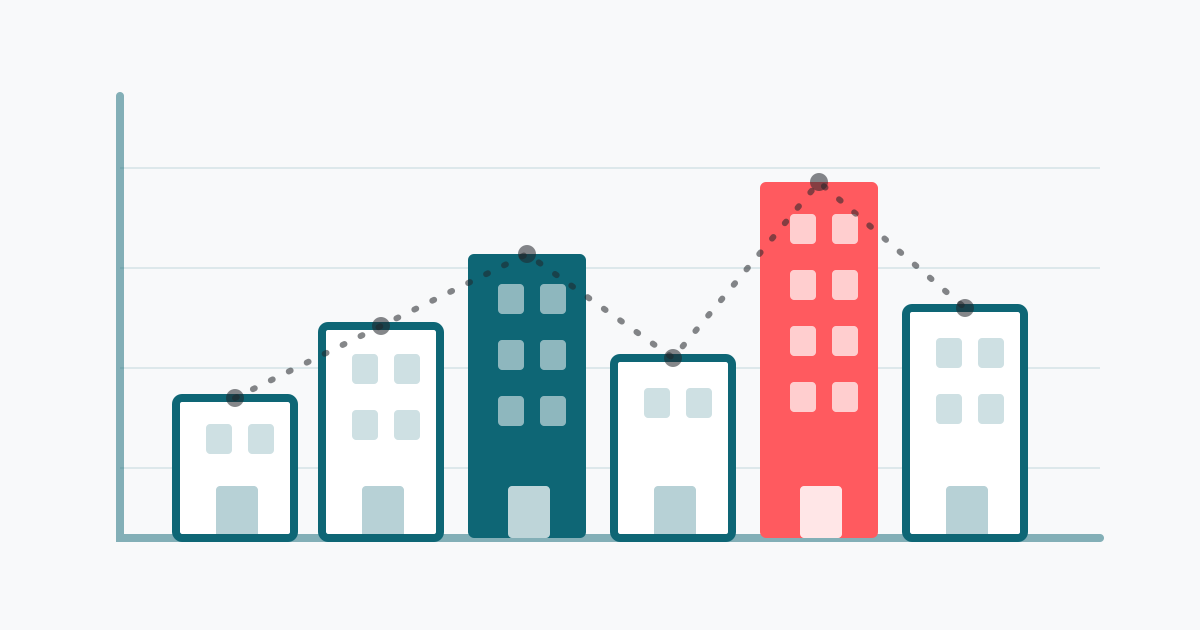
Havana concentrates most of Cuba’s real estate supply and demand — and also the biggest price differences: between an apartment in an Alamar building and a house in Miramar there can be a gap of more than twenty times.
This guide reviews the most sought-after areas of the capital and the factors that explain their prices, so you can orient your search — or the sale of your house — with context.
Playa: Miramar, Siboney and the premium segment
The Playa municipality concentrates the highest segment of the market. Miramar, with its tree-lined avenues, large houses and proximity to embassies and companies, is the most valued area in Cuba, followed by neighborhoods like Siboney, Atabey and Náutico.
Here you find the most expensive properties on the island, and also a large share of long-stay rental demand from foreign professionals and companies.
Plaza de la Revolución: Vedado and Nuevo Vedado
Vedado combines a central location, tree-lined streets and a unique architecture of eclectic houses and mid-20th-century apartment buildings. It is the favorite area for those who want to live in the "green" center of the city, and it maintains high prices and constant demand.
Nuevo Vedado offers a similar profile with a quieter residential feel. In both, the condition of the building and the floor (with or without elevator) weigh heavily on the price.
Centro Habana and Habana Vieja: the dense heart of the city
These are the densest, most central municipalities, with a lot of housing in old buildings. Prices per square meter are lower than in Vedado or Miramar, but the construction condition varies enormously: check structures, roofs and installations with special care.
In Habana Vieja, proximity to the historic center adds appeal — and tourist rental demand in the authorized zones — which sustains prices for well-preserved homes.
Diez de Octubre, Cerro and the traditional ring
Santos Suárez, La Víbora or Lawton (Diez de Octubre) offer large, solidly built houses at prices notably lower than Vedado, with good connections to the center. They are among the best value-for-money areas of the capital and concentrate much of the "real" buying and selling by Havana families.
Cerro, more heterogeneous, combines very deteriorated areas with residential pockets of good value.
Habana del Este and the outer municipalities
Alamar (Habana del Este) is the country’s largest prefabricated housing complex and one of the cheapest options to buy an apartment in the capital. In the same municipality, Guanabo and the eastern beaches attract vacation-home demand.
Boyeros, Arroyo Naranjo, San Miguel del Padrón, La Lisa, Marianao, Regla, Guanabacoa and Cotorro complete the map with the most affordable entry prices, in exchange for longer distances and commuting.
What drives prices in Havana
Beyond the area, the factors that weigh most on the price are: the real construction condition (not the listing’s "needs some work"), the water situation (an own cistern is a huge plus), the floor and access, the garage, the possibility of commercial use on ground floors and, always, documentation in order.
Always compare within the same area and type of home: on CubanPortal you can filter by municipality and neighborhood to see the real market of each area.
The fifteen municipalities at a glance
Havana has fifteen municipalities and no comparison between them works with a single figure. This table summarises what kind of housing dominates in each and what actually decides its price — the information most often missing when someone starts looking.
| Municipality | What you mostly buy | What decides the price |
|---|---|---|
| Playa | Large houses with garden and garage | Neighbourhood and corporate rental demand |
| Plaza de la Revolución | Flats and eclectic houses | The building, the floor and the lift |
| Centro Habana | Flats in old buildings | Structural condition |
| Habana Vieja | Colonial and republican housing | Restored core versus outer ring |
| Diez de Octubre | Solid houses with a yard | Roof condition and extensions |
| Cerro | Highly mixed | The specific neighbourhood, not the municipality |
| Marianao | Mid-century houses and duplexes | Floor area and water supply |
| La Lisa | Houses with land | Distance and transport |
| Boyeros | Houses with yards in towns | Aircraft noise and transport |
| Arroyo Naranjo | Self-built houses | Build quality and legalisation |
| San Miguel del Padrón | Modest housing | The specific condition of the property |
| Habana del Este | Prefabs and coastal houses | Alamar versus the beach strip |
| Guanabacoa | Spacious colonial houses | The commute to the centre |
| Regla | Small early-1900s houses | Industrial and port surroundings |
| Cotorro | Houses with a plot | Distance: the greatest in the capital |
Four rules for reading Havana prices
With that geography in mind, these four rules avoid most of the valuation mistakes made by someone new to the capital’s market.
- Compare by neighbourhood, not by municipality: in Cerro or Diez de Octubre the internal variation exceeds the variation between municipalities.
- Structural condition outweighs floor area in the old stock of Centro Habana and Habana Vieja.
- In flats, the building is worth as much as the home: lift, stairwell, roof and water pumping are part of the price.
- Documentation is not an extra: a house not registered in the seller’s name has no market price, it has a risk price.
Where to look next
This guide is the general map. For the detail of each municipality — what was built there, which neighbourhoods make it up, what to check before buying and what the market is asking today — we publish a page per municipality in the market section, with prose written for each zone and statistics computed over the active listings.
And if what you want is a figure for your own case, the calculator estimates the value of a home from the comparable listings in that same zone, telling you how many back the result.
Frequently asked questions
- Which is the most expensive municipality in Havana?
- Playa, by a wide margin. Neighbourhoods such as Miramar, Siboney and Atabey hold the most expensive homes in the country, further pushed by long-stay rental demand from foreign companies and professionals. Plaza de la Revolución, with Vedado, is the second market by price.
- And the cheapest?
- Among the most affordable are Cotorro, San Miguel del Padrón and Arroyo Naranjo, and within Habana del Este the prefabricated flats of Alamar. In all of them the factor explaining the low price is distance to the centre and transport, rather than the quality of the housing.
- Is it better to buy a flat or a house in Havana?
- It depends on the municipality. In Vedado or Centro Habana the supply is mostly flats, and there the decisive factor is the state of the building, not only of the home. In Diez de Octubre, Marianao or the outer municipalities the detached house with a yard dominates, giving more space for the same money in exchange for more distance and more maintenance.
- Are Havana prices rising or falling?
- There is no official house-price index in Cuba, so any categorical answer is an opinion. What can be observed are the asking prices in published listings, which CubanPortal computes by zone and updates continuously. Remember these are asking prices, not closed sales.
Keep reading
How much does a house cost in Cuba? Prices by zone and how to compare
Real price ranges by province and neighborhood, the factors that move them, and how to use real market data before buying, selling or renting.
Read guideHow to inspect a home in Cuba before buying it
Roof, structure, damp, water and wiring: a room-by-room checklist for the defects that cost the most to repair in Cuba, and the ones you should walk away from.
Read guide